A hospital can have excellent individual departments and still experience operational challenges if those departments do not work together efficiently.
A patient may interact with reception, clinicians, nurses, laboratory staff, pharmacists, cashiers, and administrators during one visit.
When information has to be repeatedly entered, copied, or searched for, small delays can accumulate.
This is where an integrated HMIS can make a difference.
Start With the Patient
A good hospital workflow begins with the patient.
When a patient arrives, the system should help staff establish:
Who is the patient?
Why are they visiting?
Which service do they need?
What has already happened during the visit?
An HMIS can provide the foundation for answering these questions.
Reception and Registration
The reception team can be responsible for establishing the patient's encounter.
A digital workflow can help staff:
- Search for existing patients
- Register new patients
- Create visits
- Manage queues
- Direct patients to appropriate services
This creates a digital starting point for the rest of the patient's journey.
Clinical Consultation
The clinical team then works with the patient's encounter.
Depending on the system and facility configuration, clinicians may record:
- Complaints
- Clinical notes
- Diagnoses
- Orders
- Prescriptions
- Follow-up information
The information becomes part of the patient's digital record.
Laboratory and Radiology
If investigations are required, requests can be connected to the relevant department.
Laboratory and radiology teams can then process the requests within their respective workflows.
Results can be linked back to the patient encounter so authorized clinical users can access them.
Pharmacy
Once medication is prescribed, pharmacy becomes another important part of the workflow.
The pharmacy team can review prescriptions, dispense medication, and manage relevant stock processes depending on the system configuration.
This creates a connection between clinical decisions and pharmacy operations.
Billing and Payments
The financial side of the visit also needs to be connected.
Services provided during the encounter can feed into appropriate billing workflows.
The facility can then manage payments, balances, insurance-related processes, and financial reporting.
Why Integration Matters
The benefit of an integrated HMIS is not simply that each department has its own digital screen.
The bigger benefit is that information can move with the patient's workflow.
Kenyan digital-health policy places emphasis on integrated health information systems and secure information sharing, while the Digital Health Agency describes its mandate around maintaining a comprehensive integrated health information system and facilitating health-data portability.
HOSIPOA: Connecting the Hospital Workflow
HOSIPOA is designed to bring key hospital workflows into a connected environment.
Instead of thinking about reception, clinical care, laboratory, pharmacy and billing as isolated activities, the platform is intended to help facilities manage them as connected parts of hospital operations.
That can give teams a clearer view of where a patient is within the workflow and what actions are required next.
A connected hospital workflow can look like:
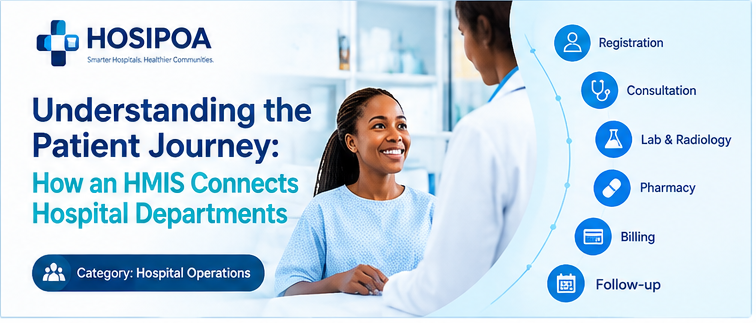
Registration → Consultation → Investigation → Results → Prescription → Pharmacy → Billing → Follow-up
The exact workflow will vary by facility, but the principle remains:
When departments are connected, information can move more efficiently through the hospital.