A hospital is not a collection of independent departments.
Although reception, consultation, nursing, laboratory, radiology, pharmacy, billing, and administration may have different responsibilities, they are connected by one thing:
the patient.
A patient entering a hospital creates a journey that may involve several departments.
A modern HMIS can help connect those interactions so that information follows the patient's journey rather than remaining trapped in departmental silos.
The Patient Journey Starts at Registration
The journey often begins when a patient arrives at reception.
The registration team may need to:
- Identify the patient
- Create or locate a patient record
- Capture demographic information
- Confirm the visit
- Assign the appropriate service
- Manage the patient queue
Once registration is complete, the patient's encounter can become the foundation for subsequent services.
From Reception to Clinical Care
The next stage may involve consultation.
The clinician needs relevant patient information to support the encounter.
Instead of asking patients to repeatedly provide the same information or relying entirely on physical files, an HMIS can provide authorized clinical users with access to information already recorded in the system.
The clinician can then document the encounter and initiate additional services where required.
Connecting Laboratory Services
Suppose the clinician orders a laboratory test.
In a disconnected environment, this may require a physical request or separate data entry.
In a connected HMIS, the request can become part of the patient's digital workflow.
The laboratory team can process the request and record the result.
Authorized clinical users can then access the result as part of the patient's record.
Connecting Pharmacy
The same principle can apply to prescriptions.
A clinician creates a prescription.
The pharmacy receives the relevant information.
The pharmacist reviews and processes it.
The dispensing activity can then become part of the patient's record and relevant financial workflows.
Instead of treating each department as an isolated system, the HMIS connects the steps.
Connecting Billing
Financial transactions are another part of the patient journey.
The hospital needs to know what services were provided and what payments or insurance transactions are associated with those services.
An integrated system can connect service activity with billing workflows, reducing the need for staff to manually reproduce information.
Why Connected Workflows Matter
Kenyan research into digital health systems has previously identified interoperability, usability, training, infrastructure, and support as important issues in hospital-system implementation.
This highlights an important point:
Buying software is not the same as creating a connected hospital.
The workflows need to work together.
One Patient, Many Departments
Consider a simple example:
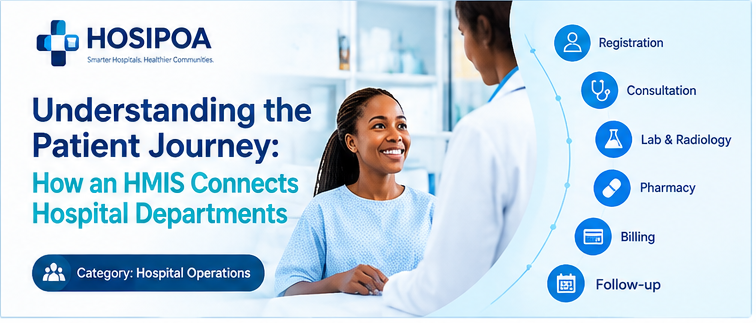
A patient registers at reception, sees a clinician, receives a laboratory request, gets the result reviewed, receives a prescription, collects medication from pharmacy, and completes payment.
Six different activities may be involved.
A connected HMIS can help make these activities part of one digital patient journey.
That can reduce duplicate data entry and improve information visibility for authorized users.
HOSIPOA and the Connected Hospital
HOSIPOA is designed to support the idea that hospital departments should work as parts of one operational environment.
Rather than treating registration, clinical care, pharmacy, laboratory, billing, and administration as completely separate activities, an HMIS can connect them around the patient's journey.
The result is a more structured approach to managing information across the facility.
The principle is simple:
One patient.
One connected journey.
Multiple departments working together.
That is one of the key ideas behind modern hospital information systems.