How a Modern HMIS Can Help Hospitals Reduce Paper-Based Workflows
For many healthcare facilities, paperwork remains part of everyday operations. Patient registration, clinical documentation, laboratory requests, prescriptions, billing, reports, and administrative records can all generate documents that need to be completed, stored, retrieved, and sometimes transferred between departments.
While paper-based processes can work, they can also create additional administrative work and make information harder to access when it is needed.
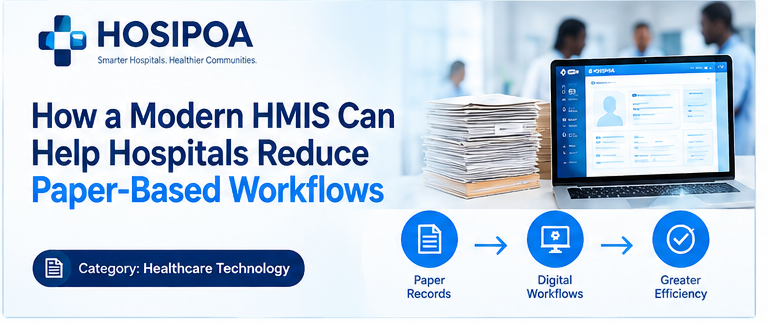
A modern Hospital Management Information System (HMIS) provides an opportunity to move many of these processes into a connected digital environment.
What Does a Paperless Hospital Mean?
Going paperless does not necessarily mean eliminating every piece of paper from a healthcare facility overnight.
Instead, it means progressively replacing unnecessary paper-based processes with secure digital workflows.
For example, instead of moving a physical laboratory request from one department to another, a digital system can allow an authorized user to create the request electronically and make the relevant information available to the laboratory.
The same principle can apply to prescriptions, billing, patient registration, reports, and other workflows.
1. Digital Patient Registration
Patient registration is one of the first processes a patient encounters.
A digital registration workflow can help staff capture patient information electronically and retrieve existing records when the patient returns.
This can reduce repetitive data entry and make information easier for authorized users to access.
It can also provide a foundation for connecting subsequent services to the same patient record.
2. Connecting Departments Through One Workflow
Hospitals are made up of many departments, but patients move between them.
A patient may:
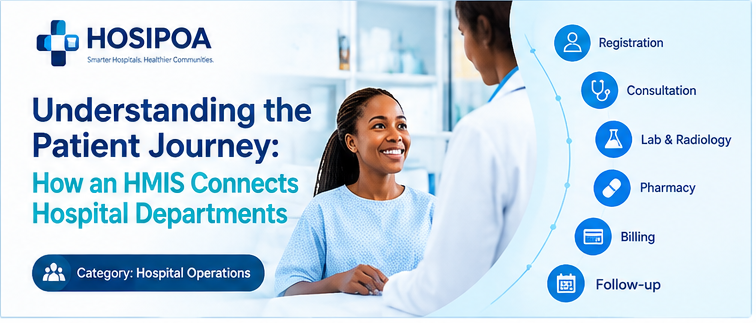
Register → See a clinician → Visit the laboratory → Receive medication → Make payment → Return for follow-up.
When each step is managed separately on paper, information may have to be copied or physically transferred.
An integrated HMIS can connect these workflows around the patient's encounter.
Kenya's Digital Health Act provides for a comprehensive integrated health information system and emphasizes privacy, confidentiality, security, and secure transfer of identifiable health data.
3. Easier Access to Patient Information
Paper files require physical storage and retrieval.
Digital records can allow authorized users to search for information from their workstation or approved device.
This can be particularly useful when different departments need information related to the same patient.
The goal is not simply to store information electronically.
The goal is to make relevant information available when and where it is needed, subject to appropriate access controls.
4. Digital Laboratory and Radiology Requests
Paper-based requests can introduce additional steps into diagnostic workflows.
With an integrated system, a clinician can create a request electronically and the relevant department can receive it within the system.
Results can then be associated with the patient's record and made available to authorized users.
This reduces the need to manually move documents between departments and can make it easier to follow the status of requests.
5. Digital Pharmacy Workflows
Pharmacy is another area where digital workflows can replace repetitive paperwork.
Depending on the system configuration, prescriptions can flow from clinical workflows to pharmacy, where authorized pharmacy staff can review and process them.
Inventory and dispensing workflows can also be connected to patient and billing information.
This can help reduce duplicated data entry and provide better visibility into pharmacy operations.
6. Digital Billing and Payments
Billing is often closely connected to patient activity.
When services are recorded electronically, the information required for billing can potentially flow into the financial workflow instead of being manually copied from paper documents.
This can make it easier to track:
- Services provided
- Charges
- Payments
- Outstanding balances
- Insurance-related transactions
- Financial reports
7. Better Reporting
A paper-based environment can make reporting a time-consuming process because information may need to be collected from multiple records.
An HMIS can capture operational information as part of everyday workflows and make it available for authorized reporting.
Hospital management can then use information such as patient volumes, departmental activity, revenue, pharmacy activity, and other operational indicators to understand what is happening within the facility.
Kenya's digital-health framework emphasizes using health data to support informed decision-making.
Going Paperless Is a Process
A hospital does not need to digitize everything at once.
A practical approach can involve starting with high-volume workflows and gradually expanding.
For example:
Phase 1: Registration and patient records
Phase 2: Clinical workflows
Phase 3: Laboratory and radiology
Phase 4: Pharmacy
Phase 5: Billing and payments
Phase 6: Reporting and management analytics
The exact sequence depends on the facility.
The Goal Is Better Workflows, Not Just Less Paper
The real value of digitization is not the amount of paper a hospital stops using.
It is what happens after the information becomes digital.
When departments can work from connected information, staff can spend less time searching for documents and more time focusing on their responsibilities.
HOSIPOA is designed around this idea: bringing hospital workflows together in a connected HMIS environment so healthcare teams can manage their work more efficiently.
A more digital hospital is ultimately about creating simpler workflows, better information flow, and a more connected patient journey.